

Resolute Reddit Man?
Thoughts on Absolute Batman that will please no one.

BCKOMIX covers comics and creating comics! Subscribe:
In my previous article, written in the wake of Daniel Warren Johnson’s ICE chokehold drawing, I briefly mentioned the (then unreleased) Absolute Batman Annual #1, based on some brief descriptions of DWJ’s story from it and the available art. I wrote my first impression:
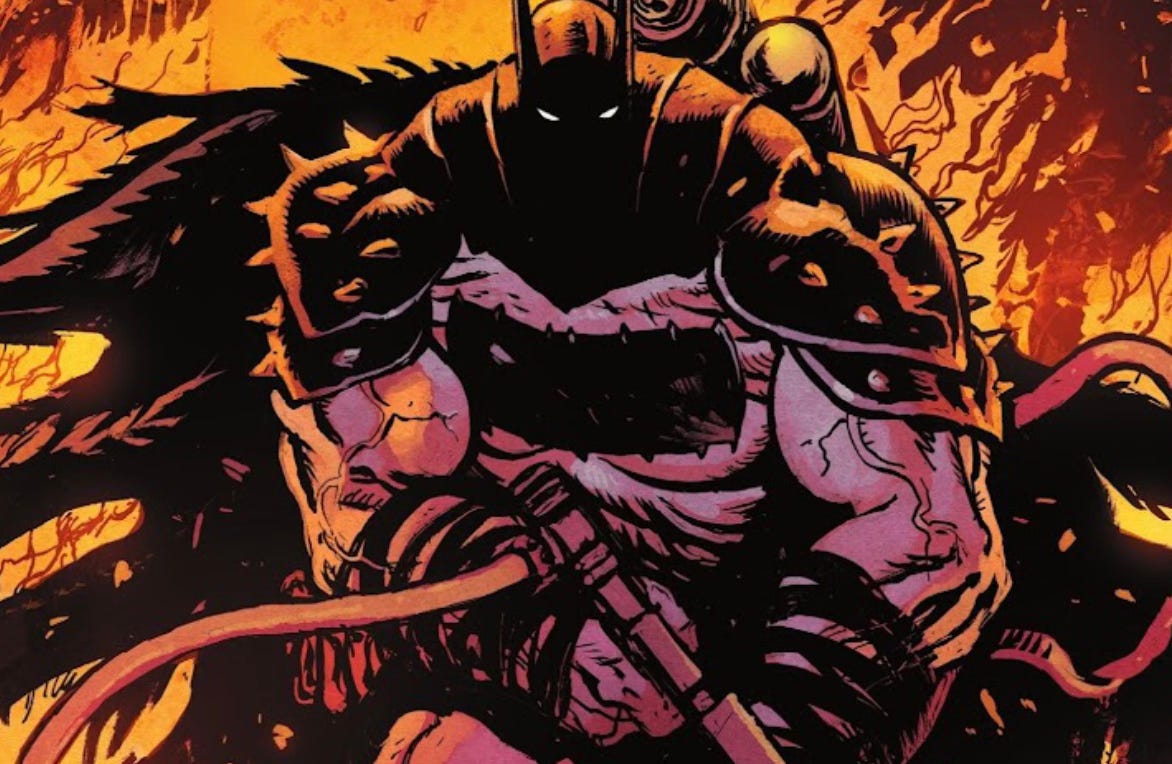
I’m not sure of the content of the book yet, but the cover looks like the literal KKK. Comics ideological interpretation is on perpetual 1940s Schomburg mode. If DWJ spent any time on X (the everything app) he would observe that the average contemporary white nationalist is not in the KKK, the contemporary white nationalist is … gay.
That was my un-subtle way of addressing the un-subtle approach to politics in American mainstream comics. Not that I disagree with DWJ on the broader strokes, just that the constant reduction of the far right as 1930s-style jackboot thugs seems incongruent when on 2025 Earth Prime they’re more likely to be keyboard warriors and assorted grifters competing for audience share, and poasting edgelord AI propaganda while infighting.
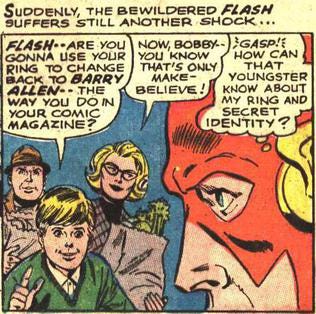
But I decided not to just go off of first impressions and check out DWJ’s story. I don’t plan on making a habit of covering many contemporary mainstream comics because they’re not my bag, but I did binge every issue of Absolute Batman so far to see what the hype was all about. I’ve come across fellow old school comic enthusiasts expressing their disgust with the title, that it didn’t stay true to the characters, that it was gratuitously violent, nihilistic, etc.
I have instant rapport with any comic reader who mostly enjoys comics before the turn-of-the-century, but I’d describe my vintage comics enthusiasm as Cartoonist Kayfabe coded, that is it’s mostly due to aesthetic and craft reasons rather than the current complaints over lack of virtuous heroics or the litany of conservative political grievances (though I agree the trite, forced radlib politics of le woke era were lame, simply because they made for bad writing). My vintage appreciation also covers 60s-70s underground comix and the edgelord indies of the 90s, so excessive sex and violence is always welcomed in BCKOMIX’s collection.
So I was prepared for the ultimate edgelord dark knight with Absolute Batman and got … well, roid rage Batman with cool vidya game weapons. There are significant changes to the character, he’s more willing to maim. And millionaire Bruce Wayne was originally created when noblesse oblige was at least still paid lip service to, so this Wayne is a working class kid. I’m always surprised how these latter day writers like Scott Snyder still get mileage out of these postwar consensus characters, it speaks to the writers’ deftness but also the archetypal quality of the characters (which I find more pronounced in DC’s DNA than Marvel).
And that archetypal quality is still there. The classic Batman characteristic that’s elevated in Absolute Batman is his idealism. Batman is essentially an uncompromising change-agent disgruntled with the system, and that’s what the title hones in on to appeal to contemporary readers. I don’t find Batman himself nihilistic at all in the series, Frank Miller’s interpretation of the character (which this series takes some design cues from) was much more cynical and dark.
As for Gotham’s corner of the Absolute Universe, Darkseid definitely fucked it up, but aside from news reports of Black Mask’s Party Animal cult (they torch day cares and dance in front of them) I didn’t find much that rivaled the edgelord comics I dig (like Faust) … that is until the brutal Bane arc. At that point the comic lived up to some of its online notoriety. That storyline is especially dark and violent, it’s also the most well written and drawn part of the series. It’s at that point I got invested. There are elements in the series that suggest it could be taken to a whole other level, time will tell.
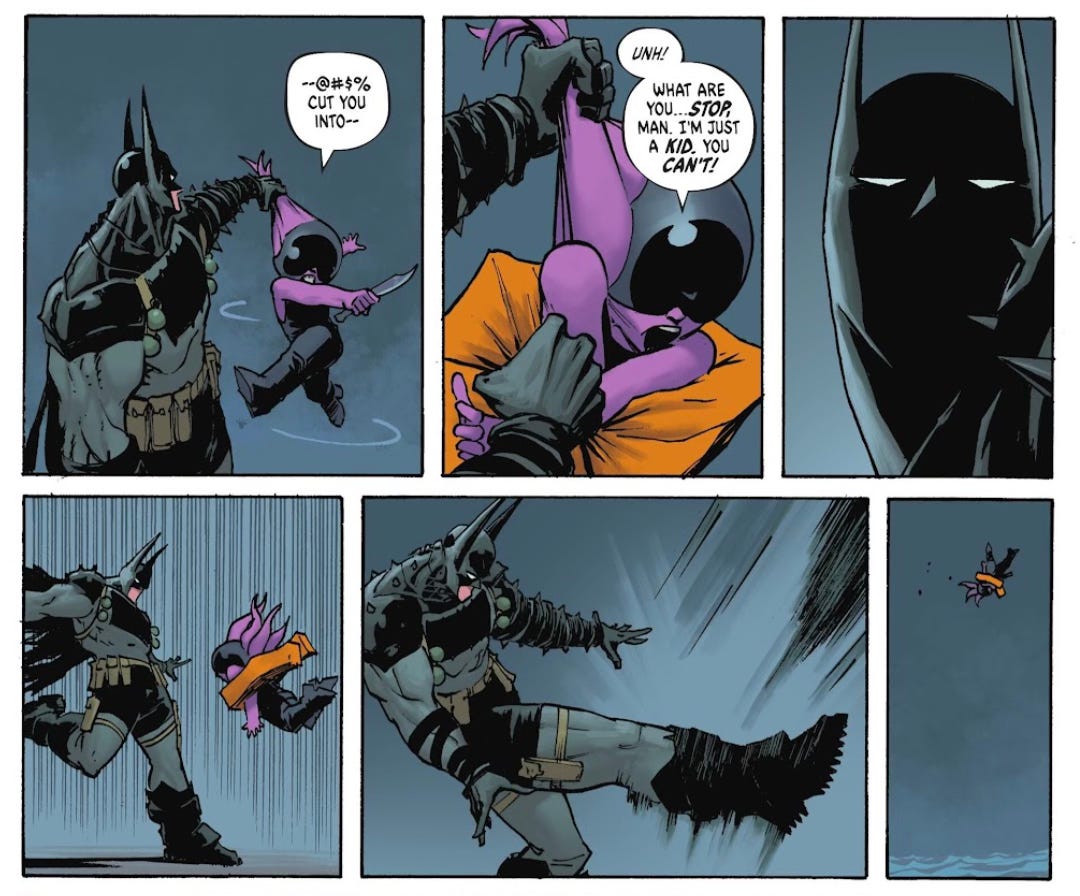
So overall I rate the title alright, so far anyway. At its best it feels like a Micheal Mann movie, sleek and stylish. Snyder’s plotting is tight and main artist Nick Dragotta especially shines in fight scenes and impressive spreads (though I think almost all of these new artists could take some lessons from the classic soap opera strips in conversational scenes). And though digital coloring usually drives me bonkers, Frank Martin’s colors work well for the mood of the book, and Mark Spicer’s colors on DWJ’s story are especially good (as partial as I am to the halftone-coloring of yore there is a new wave of colorists who rediscovered storytelling through color and don’t just use Photoshop to dump shitty airbrush modeling on everything).
Much of it feels like a silly game of discovering how classic characters will be portrayed in this new world, but that’s the whole gimmick of the Absolute Universe. It reads more like a manga than my or my grand-pappy’s Batman, but this isn’t a bad thing. This Batman is also readymade for inevitable tie-ins and adaptations, already Dragotta wants to see a Studio Trigger anime (and as a fan of the studio that’s top choice). I sympathize with my fellow old-heads whose Batman ideal was forged by O’Neil-Adams, casting a shadow for decades, but anything that brings new readers to American comics is fine-by-me at this point. It’s not like the multiple patched costumes, distorted anatomy, and holographic covers of my 90s youth were high art. But they were an initiation.
Since the politics of DWJ’s story sucked up so much discourse, it’s relevant to note that any politics in the ongoing series are more subtle. Batman being a working class hero is the most obvious statement. An economically stratified city is the ambient noise of the series, Black Mask weaponizes Gotham’s down-and-out populace, Batman eavesdrops on a party where lobbyists are wooing politicians into betraying their constituents. Arkham is recast as a black site, Ark-M, where absolute crimes against humanity take place.
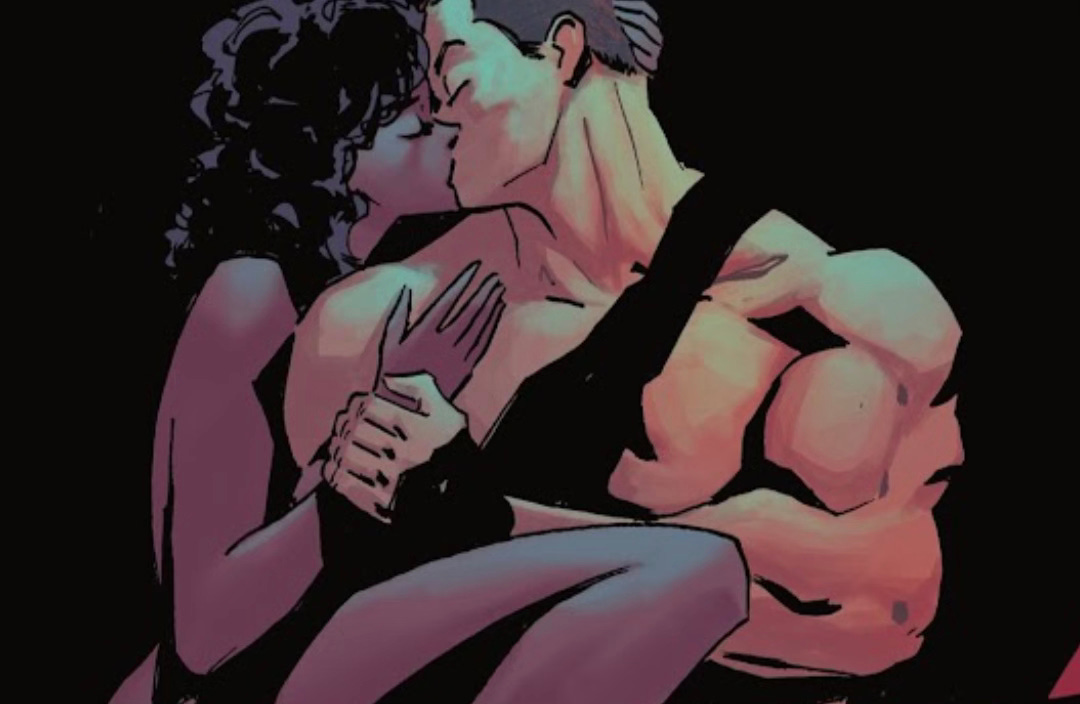
Personally I think it’s refreshing that economics and systemic decay are the target rather than the pandering idpol that socially liberal writers were obsessed with during a decade of comics I mostly ignored. There are some of the often criticized race-swaps, such as Barbara Gordon. I hardly think of Catwoman as a race-swap since there’s a long tradition of her being portrayed by black women. As always she’s a mighty fine feline, which explains why Batman went to the mat with white supremacists, her Afro-Brazilian pootie-tang is worth going to war over.
Which brings us back to DWJ’s annual story. Since he both wrote and drew the short story it appeals to my natural sensibilities, as I hold the writer-drawer hybrid model of the cartoonist as the epoch of human achievement. But DWJ would be the first to recognize he’s not a subtle storyteller (he’s acknowledged it in multiple interviews), so hardly brings the subtext a polished writer like Snyder does. DWJ is clearly angry about what’s going on in America (and has reached his city of Chicago, as he’s talked about on stream and during an interview), and the story is a clear catharsis for his anger.
There’s also something to how cartoonists often approach stories. Instead of plot points they often think in terms of visuals, and symbols. In a recent interview DWJ explains how his (much memed) spread of Batman breaking an arm reaching for a white power salute was the first image to come to mind, and the focal point he built the story around. It’s a potent symbol, and combined with cartooning’s propensity for caricature, explains how subtlety takes a backseat to melodrama. And I don’t even think it’s a bad thing in all cases, I’m not one of those who think comics have to be Dostoevsky. But it doesn’t make for the most nuanced social commentary. But hell, the same can be said for many of EC’s social issue comics, and they’re now considered iconic.
DWJ’s propensity for bold cartooning is why I enjoy his work. I always dig his kinetic style that looks like it’s borne of countless hours experimenting on paper with OG tools (and zips!). He’s not afraid to be raw and cartoony, a refreshing change from so much generic shit in comics (Netflix pitch art I call it). His intro to comics was Calvin & Hobbes, and seeing how Hobbes’ belly extended when he tackled Calvin. These cartoon physics can be seen in the story when Batman stretches while pummeling his adversaries and their heads become deflated balloons. A defeated character even has X’s for eyes. More of this cartoon kino in comics, please!
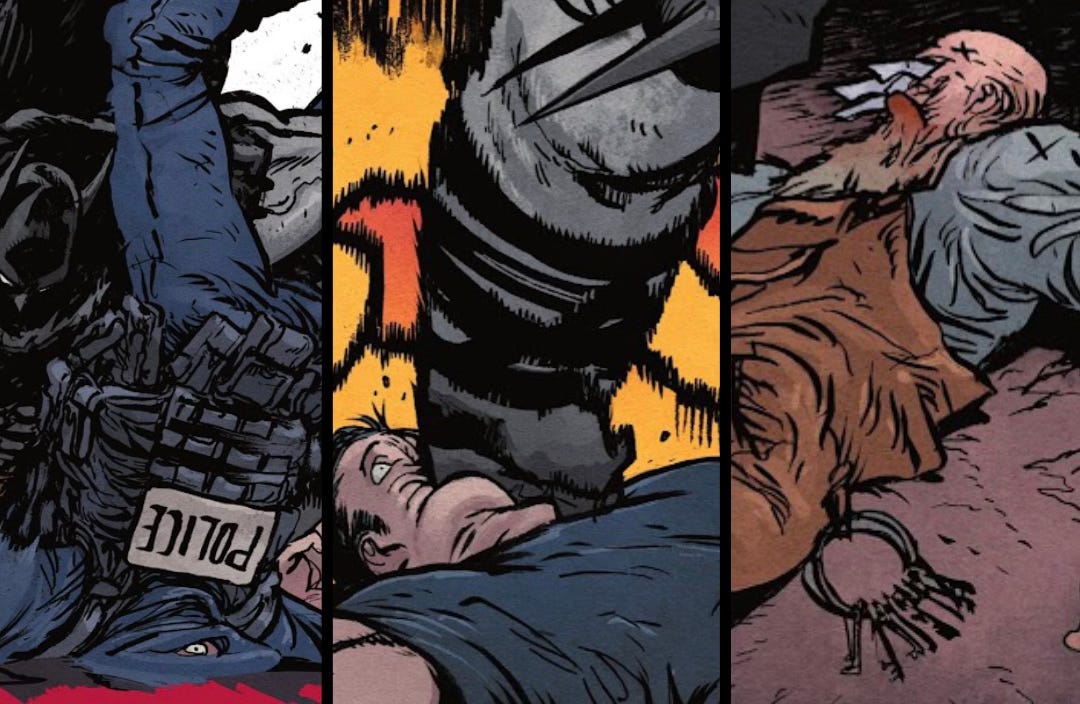
But of course it was the content that drew the attention. The story is basically a build-up to a huge fight scene framed by flashbacks with Thomas Wayne. DWJ pays at least some story-service to how economic pressures lead to cultural pressures, as the story takes place in Slaughter Swamp (traditionally known as the home of Solomon Grundy), which feels more like a Rust Belt town down on its luck. It once had a company that came in and promised jobs, but that didn’t pan out (Absolute NAFTA?) and it became a migrant camp. Everything unfolds as expected, young men of the town have been indoctrinated into white supremacist cult, beat up immigrants, the police side with the cult, so Batman beats up white supremacists and the police. The cult’s leader, Deejay, looks like he could be Mexican or Indian, so could easily be a white supremacist on X, the everything app.
Much has been made about the priest character, Father Peters. He’s an admirable figure, not portrayed as corrupt or a chomo. Here he’s framed as the originator of Batman’s “no-kill” rule, and brings some moral ambiguity into the conflict, questioning if Batman is doing the right thing. I’d wager there’s an autobiographical dynamic here, as both Father Peters and Batman represent two wolves (or a lamb and a wolf) inside DWJ himself. A conflict between a religion of redemption and righteous anger.
From a 2023 interview from The Comics Journal:
I still identify as a Christian, but that comes with such a weight now. Even more so than before, 2015, 2016. You know, now it has all this baggage. It always did, but it has even more so, and it feels kind of naïve to talk about it. I feel a little bit like: am I a fool when I talk out loud? My doubts are very, very strong, very intense. So, that’s one of the reasons why I keep it so close to the chest - because I’m like, do I sound like an idiot right now? I think that there are, at the very least, truths that I still believe in very strongly that originate from my faith, but I would hope are pretty universal, that will translate through the work that I make.
That story garnered the predictable reactions, counter-memes, and the (not-off-the-mark) “the character agrees with me” accusation. DWJ obviously wants Batman to agree with him. But a lot of other readers also seem to want Batman to agree with them, I come across posters wanting Batman to fight their chosen nemeses whether it’s Antifa or Muslim rape gangs. Guess when Batman goes public domain there’ll be a crowdfunded Batman vs. Antifa Supersoliders. Also when the Joker goes public domain he’ll have to pull out his Iranian Ambassador get-up from A Death in the Family.
The online accusation I always find most amusing is calling something Reddit. When right-wingers call something Reddit it’s usually a synonym for libtarded. But Reddit has a lot of associated connotations. It often involves virtue signaling. Love of media with obvious but simplistic messaging like “actually racism bad.” It usually means something’s more earnest. And like everything earnest it has the potential to be more cringe. More normie.
And since Generationology is how everything on the internet is usually categorized (besides politics), Reddit is often associated with Gen-X and older millennials (though a quick Google search tells me the platform trends younger, that’s not the general perception).
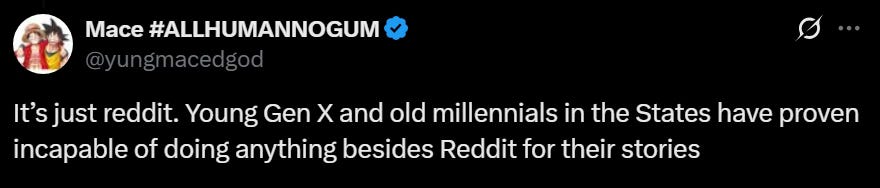
DWJ’s story was called Reddit. And it does fit many of those categories. But to his credit DWJ is likely blisfully unaware of such terminally online bullshit. But it poisons my brain. Is Absolute Batman as a whole Reddit?
It’s hard to say, the title was also big on Tik Tok and is loved by zoomers. But in any case, it’s an example of how American pop culture is so defined by the online discourse around it, and I’m sure the creators and companies take advantage of this (why wouldn’t they?). As I delved into last time, political controversy creates electric buzz around entertainment. But it does go beyond politics, it’s in fandom. In the case of Absolute Batman the buzz is around what’s changed with the characters, and the tension with the older fandom who have certain expectations of those characters.
The internet loves a strong, polarizing opinion. For all the above reasons Absolute Batman seems to garner a love or hate reaction. All I can say is it’s alright. Not bad. Very engaging in some parts. Interesting at least. Worth a read, at least to see what’s resonating with newer readers. I enjoy the DWJ story as a cathartic work. I kinda find the entire Absolute Batman project more interesting as a cultural phenomenon. But sometimes with these things you have to disconnect from all the online cultural noise to have an independent opinion on the work itself, and then you find out your opinion is … meh, whatever.
And if you want to escape the online cultural noise altogether there’s always the back issue bins.
Back issue bin gang rise up!